With the proliferation of online video services, it's easy to confuse IPTV et streaming. Netflix, Disney+, Amazon Prime Video, DAZN… do these platforms count as IPTV? And is IPTV streaming? The answer is far more nuanced than it seems.
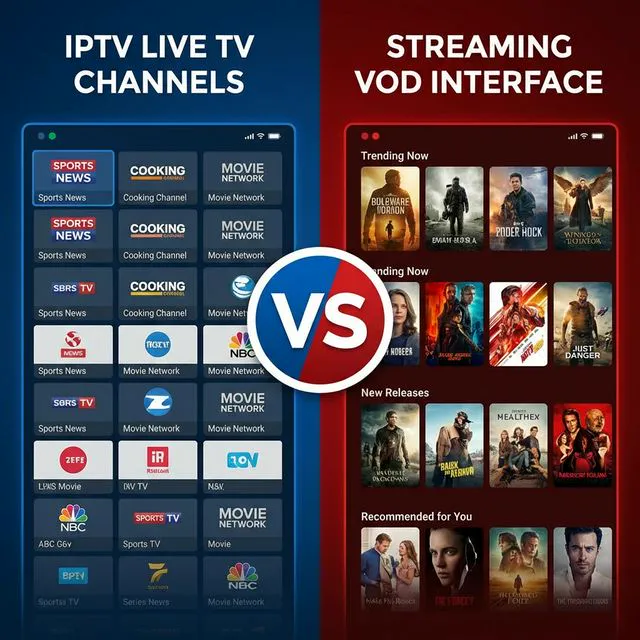
In this article, we clear up these terms, compare the two approaches objectively and explain why IPTV is often the best option for television enthusiasts in the UK.
Definitions: IPTV, Streaming, OTT and VOD
Before any comparison, let's define each term:
IPTV (Internet Protocol Television)
Diffusion de live television channels over the internet, with a programme guide (EPG), Replay and often VOD. IPTV recreates the traditional TV experience (channel-hopping) but over an internet connection. It is a dedicated network with a controlled quality of service.
Streaming / OTT (Over-The-Top)
Diffusion de on-demand content over the open internet. Netflix, Disney+ and Amazon Prime are OTT/streaming services. You pick what you want to watch from a catalogue, whenever you like. No live channels, no channel-hopping.
VOD (Video on Demand)
Catalogue de films and series that you watch whenever you like. That's Netflix's delivery model. IPTV often adds VOD on top of the live channels.
En highlights : IPTV = live channels + Replay + VOD (all-in-one). Streaming = VOD only. IPTV relies on streaming technology to deliver, but offers a far more complete service.
Comparison Table: IPTV vs Streaming
| Criterion | IPTV | Streaming (Netflix & co.) |
|---|---|---|
| Live channels | 36 000+ channels | Non |
| VOD (films and series) | 80 000+ titres | Limited catalogue |
| Live sport | All inclus | Very limited |
| Catch-up / Replay | 7-14 days | Non applicable |
| EPG (programme guide) | Complete | Non |
| Contenus originaux | ️ Non | Yes (Netflix Originals…) |
| Max quality | 4K Ultra HD | 4K Ultra HD |
| Number of channels/titles | 36 000+ channels + 192 000 VOD | 5,000 to 15,000 titles per service |
| Prix monthly | From £10.99 (all-in) | 6-£25 par service |
| Multi-screen | 2-4 screens | 1 to 4 screens (depending on the plan) |
| Devices compatibles | All devices (TV, mobile, PC…) | All |
Live Channels: IPTV's Real Advantage
The fundamental difference is clear: Netflix and Disney+ offer no live TV channels. No BBC One, no BBC Two, no BFM TV, no TNT Sports. To watch the 8 o'clock news, a football match or a live show, standard streaming will be no help to you.
IPTV, on the other hand, faithfully reproduces the classic television model: you have a grid of channels, you channel-hop with your remote and you follow what's on live. The difference from cable or satellite? The streams travel over the internet, which allows better quality and total flexibility.
What IPTV lets you follow live:
News
News on BBC One/BBC Two, BFM TV, CNews, LCI, Franceinfo
Sport
Premier League, Champions League, Rugby, F1, Tennis
Divertissement
Koh-Lanta, Top Chef, The Voice live
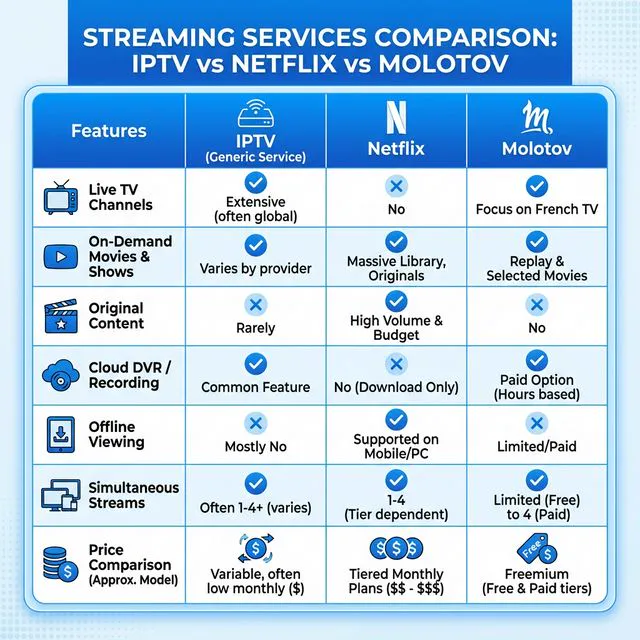
The Cost: IPTV vs Stacking Up Streaming Platforms
This is arguably the most compelling argument. Plenty of households pile up several streaming subscriptions. Let's work out the real monthly cost:
A complete IPTV plan (channels + VOD + sport):
£10.99 — £14.99/month
Économie : jusqu'à 65-£70/month that's 780-£840/an
To dig deeper into the savings you can make, take a look at our article Cheap IPTV UK.
Sport: The Achilles Heel of Standard Streaming
If you're a sports fan, the question is quickly settled. Standard streaming platforms are all but useless for live sport:
Streaming Classique
- No Premier League (apart from paid DAZN)
- No Champions League
- No Premier League
- No live Rugby or Tennis
- No F1 or MotoGP
- ️ Amazon: a few L1 matches (as a paid add-on)
IPTV
- Full Premier League (DAZN included)
- Champions League on TNT Sports
- Premier League, La Liga, Serie A
- Top 14, Six Nations, Wimbledon
- F1, MotoGP on Sky Sports
- TNT Sports, Sky Sports, Eurosport included
For football fans, browse our dedicated guides: Follow Premier League et Champions League on IPTV.
VOD: IPTV Holds Its Own Against Streaming
It's tempting to assume standard streaming dominates on VOD. That's less and less true. Quality IPTV services now include impressive VOD catalogues:
| Service | Catalogue | Originaux | New releases |
|---|---|---|---|
| Netflix | ~15 000 titres | Oui | Hebdomadaire |
| Disney+ | ~10 000 titres | Oui | Hebdomadaire |
| Amazon Prime | ~12 000 titres | Oui | Hebdomadaire |
| IPTV UK | 80 000+ titres | Non | Quotidienne |
The only tangible advantage standard streaming keeps is exclusive original productions (Stranger Things on Netflix, The Mandalorian on Disney+, etc.). If those exclusives matter to you, there's nothing stopping you keeping a streaming subscription alongside IPTV — you'll still save by cancelling the others.
Which Choice Should You Favour Based on Your Profile?
Famille nombreuse
Children clamouring for cartoons, parents in front of the news, teenagers hooked on sport…
→ IPTV: the all-in-one solution for the whole family, multi-screen included
Sports fan
Football, rugby, tennis, F1… You need all the sports channels.
→ IPTV: a must. Standard streaming ignores live sport.
Film buff
Wants the new Netflix series, the Disney+ exclusives…
→ IPTV + 1 streaming platform. IPTV for the massive catalogue + one platform for the exclusives.
Expat
Wants to watch French TV from abroad.
→ IPTV: the only way to access French channels outside France.
Tight budget
Wants maximum content at the lowest price.
→ IPTV: £10/month instead of £80+ of stacked subscriptions.
Technical Architecture: Multicast, Unicast and CDN
To grasp the real difference between IPTV and streaming, you have to look under the bonnet. Three network architectures coexist in 2026:
Multicast (IPTV from the operators Free, Orange, SFR)
A single broadcast stream is intelligently duplicated within the network and received simultaneously by all subscribers. Very economical on bandwidth, near-zero latency (1–2 seconds), but the operator has to control the whole network (hence why it's reserved for ISP boxes).
️ Unicast (OTT IPTV / independent services)
Each user receives their own dedicated stream from the server. This is the model used by independent IPTV services like ours. Slightly higher latency (5–15 seconds), but it works over the ordinary internet, without depending on an operator.
CDN HTTP Adaptive Streaming (Netflix, Disney+, Prime)
The content is split into chunks of 2–10 seconds, hosted on a worldwide network of CDN servers, and delivered on demand in HLS or DASH format. No live is possible: everything is pre-encoded VOD. Excellent adaptive quality but zero live.
Conclusion technique : IPTV (both multicast and unicast) is designed for low-latency live TV. OTT streaming (Netflix...) is designed for large-scale VOD with automatic quality adaptation. These two worlds converge without fully replacing one another: this is why the best IPTV services combine VOD + Live, drawing on both approaches.
Business Model: Why Does IPTV Often Cost Less?
Netflix-style streaming platforms spend more than £15 billion each year on producing original content. Hence a Netflix subscription at £13/month minimum, and comparable prices for Disney+ and HBO Max. IPTV, by contrast, produces nothing: it aggregates existing channels (BBC One, Channel 4, TNT Sports, Sky Sports) and redistributes their signal over the internet.
An IPTV service's cost structure focuses on infrastructure (servers, CDN, bandwidth), technical support and legal compliance — some 70 to 80% of the budget. No £100 million blockbusters, no stars at £25 million per film, no in-house production teams. That's why a complete IPTV plan (channels + VOD + sport) stays at £3–10/month, when a stack of streaming platforms easily tops £50/month for the same coverage.
IPTV is therefore not a head-on rival to Netflix, but an economically complementary aggregator. Many users keep Netflix (for the exclusive originals) and add an IPTV subscription (for everything else: sport, terrestrial TV, recent Hollywood films, international series).
Frequently Asked Questions — IPTV and Streaming
L'team EzzeTV
IPTV and streaming specialistsExperts in streaming and IPTV in the UK, our editorial team tests and compares services, apps and devices day in, day out to bring you reliable, up-to-date guides that reflect the reality of the French market in 2026.
Choose IPTV: All-in-One from £10.99/month
36,000 channels + 192,000 VOD + Full Sport + Replay • 12 months at £51.99 (£4.33/month)
Explore Our Offers